
31 October 2026
How to Plan Your Month: Building 2027 on the Wall, One Month at a Time
Planning your month takes half an hour on its last evening. What to write on the wall, in what order, and what to do when the plan falls apart.
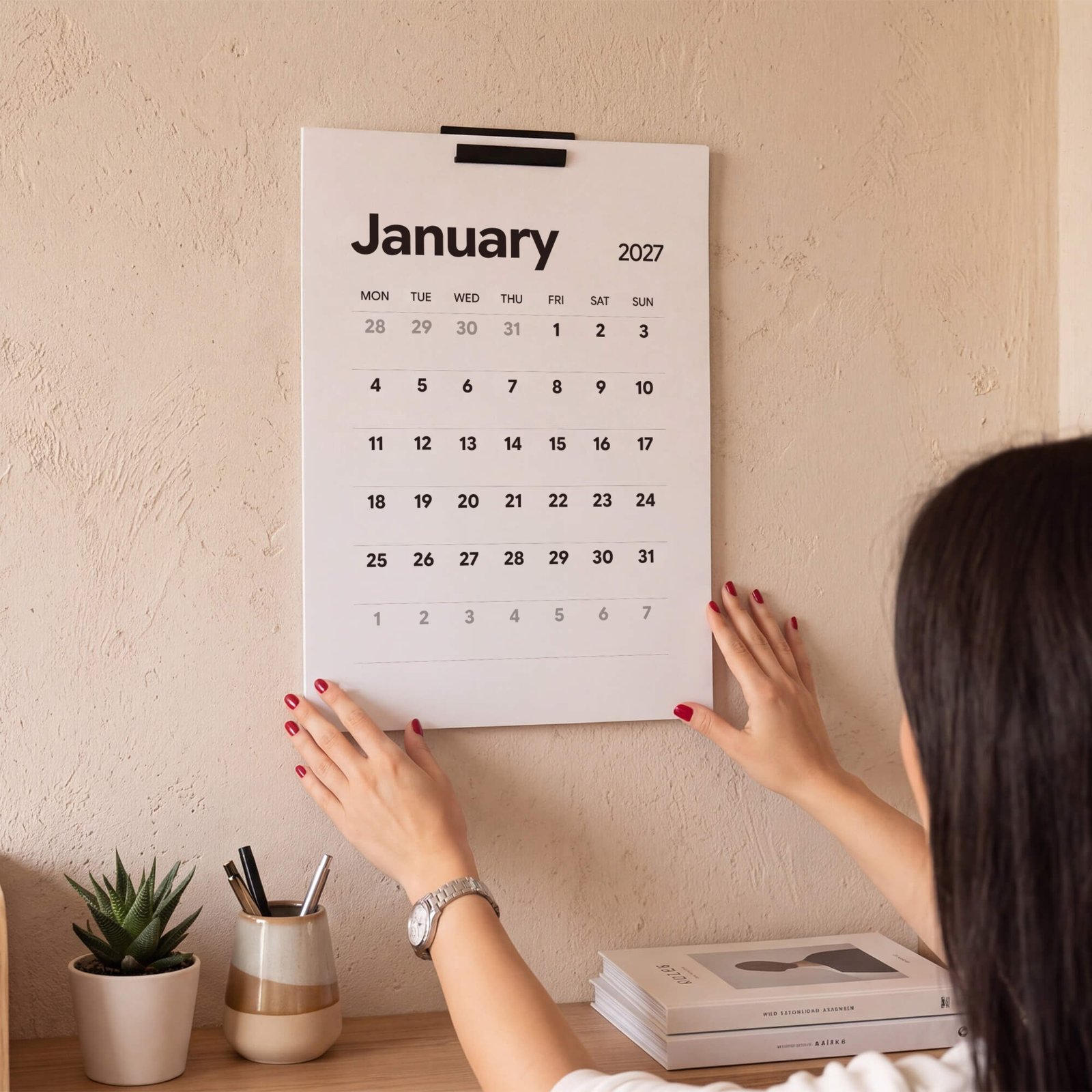
Planning a month sounds like a big job, but the problem is rarely the plan itself; it's where the plan lives. An appointment in your phone gets seen once, when the notification pops up. A sheet on the wall is in front of you every day, whether you want it or not, and that's much of what makes a monthly plan stick.
Here's how we set up a month on a wall calendar: what we write, in what order, and what we do when the plan falls apart. The method works with any calendar; our examples use our own grid-layout sheets.
The last evening of the month: a half-hour session
Plan a month before it starts, not after. Pick the last Sunday or the last working day and sit down with your phone, your work calendar and a pen. Half an hour is plenty; if it takes longer, you're probably planning the year, not the month.
There are three steps: write down what you already know, choose a few things that matter, and leave the empty space alone. The last one is the hardest.
Fixed dates first, intentions second
The fixed dates
The first pass is for what isn't up for discussion: birthdays, rent and bill due dates, the parent-teacher conference, a doctor's appointment, a flight, a deadline. Copying them over is tedious, but they're the bones of the plan.
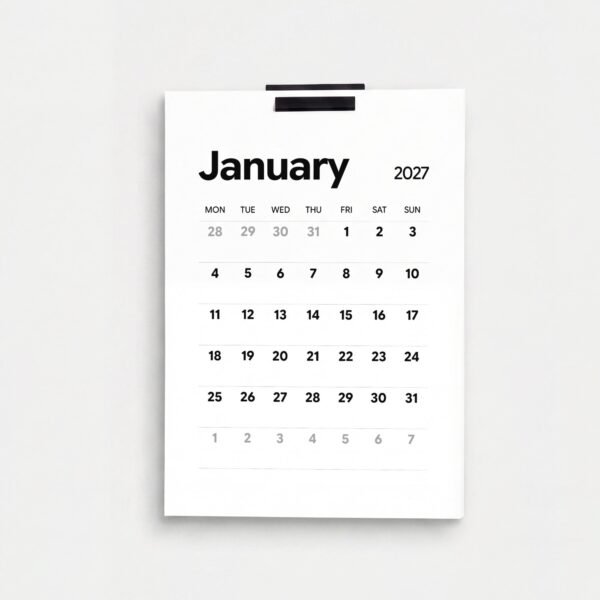
One small thing about 2027: the year starts on a Friday, so January opens with three days before the first full week begins on Monday the 4th. Use those first days as a warm-up and carry over the dates you already know for the whole year: birthdays, vacation you've booked, a family visit. Spotting your days off early leaves room for a short trip.
Intentions: three things for the month
The second pass is for what you choose, and we keep it deliberately small: three things a month. "Clear out the bathroom cabinet," "finish the first draft of the presentation," "spend a weekend at my parents'." Each can really be finished within the month, and you'll know when it is.
Give each one a day. An intention without a date usually ends the month still an intention. You can always move it; what matters is that it has a place on the page.
Write less, and write it to be read
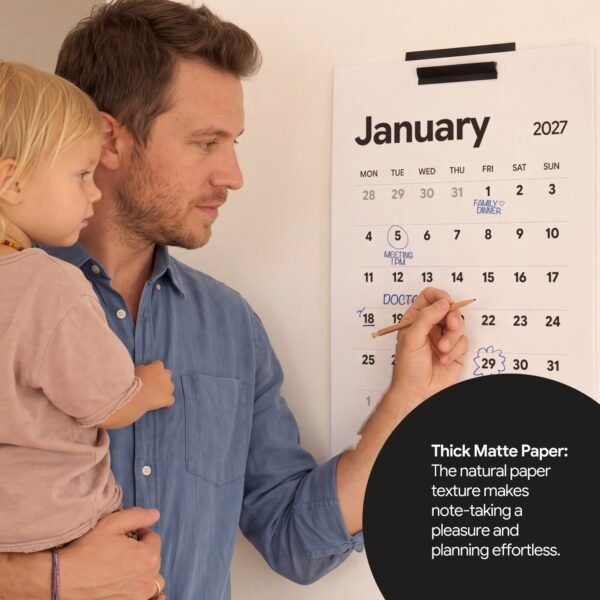
A wall calendar is read from across the room. If you can't make out a box from the other side, it's too full. Our rough rule: two lines per box, two or three words per line. "2pm dentist" is enough; the details can stay on your phone. The wall only has to remind you.
Go easy on color, too; more than three and the grid gets busy. One dark pen for fixed dates and one color for your three things covers most months. When something's done, put a small check mark in the corner instead of scribbling over it.
Paper matters more than you'd think. On glossy stock, felt tips smudge and ballpoints skate. That's why we print on 200 g/m² matte paper, which takes a fine-tip felt pen without fuss.
How to keep the plan alive through the month
Your plan will break in the second week. That isn't failure; it's what months do. What counts is what you do next.
Once a week, ideally Monday morning, spend two minutes at the calendar. If something didn't happen last week, don't cross it out; draw a small arrow and move it to a new day. Those arrows become the most honest record of what keeps getting postponed. A task moved three times either matters less than you thought or needs splitting in two.
Hang the calendar where that look is easy: above your desk, beside the fridge or by the front door, at eye level, not at the end of a hallway. If you'd rather not drill, the PlanCORE™ Wall Bracket holds to smooth surfaces with the double-sided tape on its back; for concrete or wood, two nails come in the pack.
The one place everyone at home looks
A less obvious benefit of a monthly plan is that everyone at home sees the same thing: who's late which night, the kids' school trip, the weekend the in-laws come to stay. When all that lives on separate phones, you hear "But I told you!" a lot.
A family calendar doesn't need its own system. Give each person a letter or a color and invite them to the last-evening session for ten minutes. Kids who write in their own plans check the calendar more often. Adults aren't so different.
For a shared calendar, A3 (29.7 × 42 cm, about 11.7 × 16.5 in) gives everyone room; for a personal work calendar, A4 (21 × 29.7 cm, about 8.3 × 11.7 in) fits better. Our wall calendars page compares the two.
Before you turn the page
Before next month's session, give the old sheet a minute. Check marks, arrows, blank days: how the month really went is all on one page, and it helps you choose the next three things.
Keep the old sheets. At the end of the year, all twelve stacked together tell you more than any year-in-review your phone serves up.
Our 2027 wall calendar comes with twelve monthly grid sheets and a wall bracket, in English with a Monday or Sunday week start. The bracket stays up; next year you only replace the sheets. To carry the plan day by day at your desk, see our post on daily planning.
To set up the system in this post: Duvar Takvimleri
Products in this post
-
 16% Off
Featured
Wall Calendar
PlanCORE™ Wall Calendar Set 2027
Minimalist Wall Calendar
- A3 · A4
- 6 languages
From Original price was: €18,90.€15,90Current price is: €15,90. Options This product has multiple variants. The options may be chosen on the product page -
 25% Off
Refill Sheets
PlanCORE™ Wall Calendar Refill 2027
Wall Calendar Refill Sheets
- A3 · A4
- 6 languages
From Original price was: €15,90.€11,90Current price is: €11,90. Options This product has multiple variants. The options may be chosen on the product page -
 Featured
Wall Calendar
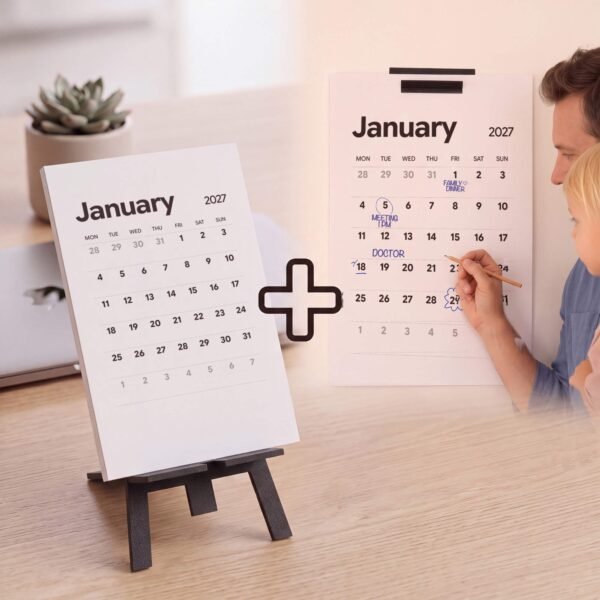
PlanCORE™ Wall and Desk Calendar 2027
Minimalist Calendar Set
- A3 · A4
- 6 languages
From €19,90 Options This product has multiple variants. The options may be chosen on the product page